Every founder I know is currently telling themselves some version of the same story: this is the most disruptive moment technology has ever thrown at a business owner. I believed that too, for about as long as it took to actually go check.
On the Beyond The Prompt episode featuring cognitive neuroscientist Chantel Prat, host Jeremy Utley read out an old bit from Douglas Adams, the author of The Hitchhiker’s Guide to the Galaxy. Adams had a set of rules for how people react to new technology. Anything that already exists when you’re born is just normal, part of the furniture. Anything invented between the ages of fifteen and thirty five is new and exciting, maybe even a career. And anything invented after you turn thirty five is, in Adams’ words, “against the natural order of things.”
That line landed because it names the bias before it asks anyone to drop it. The panic you feel about AI right now is mostly a function of your age, when the technology showed up relative to your own timeline, and how much you’d already built before it arrived. Worth knowing that about yourself before you make a strategic call based on how AI feels rather than what it actually does.
Every era has believed it was living through the most disruptive moment in history. That belief is usually correct, and also completely useless, because it was equally true of every person who came before you.
The only lever you actually have is your response
This is where the Stoics earn their keep, as an operating framework for how you run a business through disruption. Ryan Holiday, who has spent years writing about ancient philosophy for a modern audience, made a point on his own episode of Beyond The Prompt, Marcus Aurelius wrote obsessively about change, more than almost any other subject in Meditations, and his core move was to point out that the status quo you’re defending was itself the product of change you once resisted.
“When you’re frightened of change,” Holiday said, describing Aurelius’ thinking, “you should remember that the status quo that you’re trying to preserve was itself a product of change.” You weren’t always the size company you are now. Your industry wasn’t always structured the way it’s structured today. Somebody, at some point, was scared of becoming what you currently are.
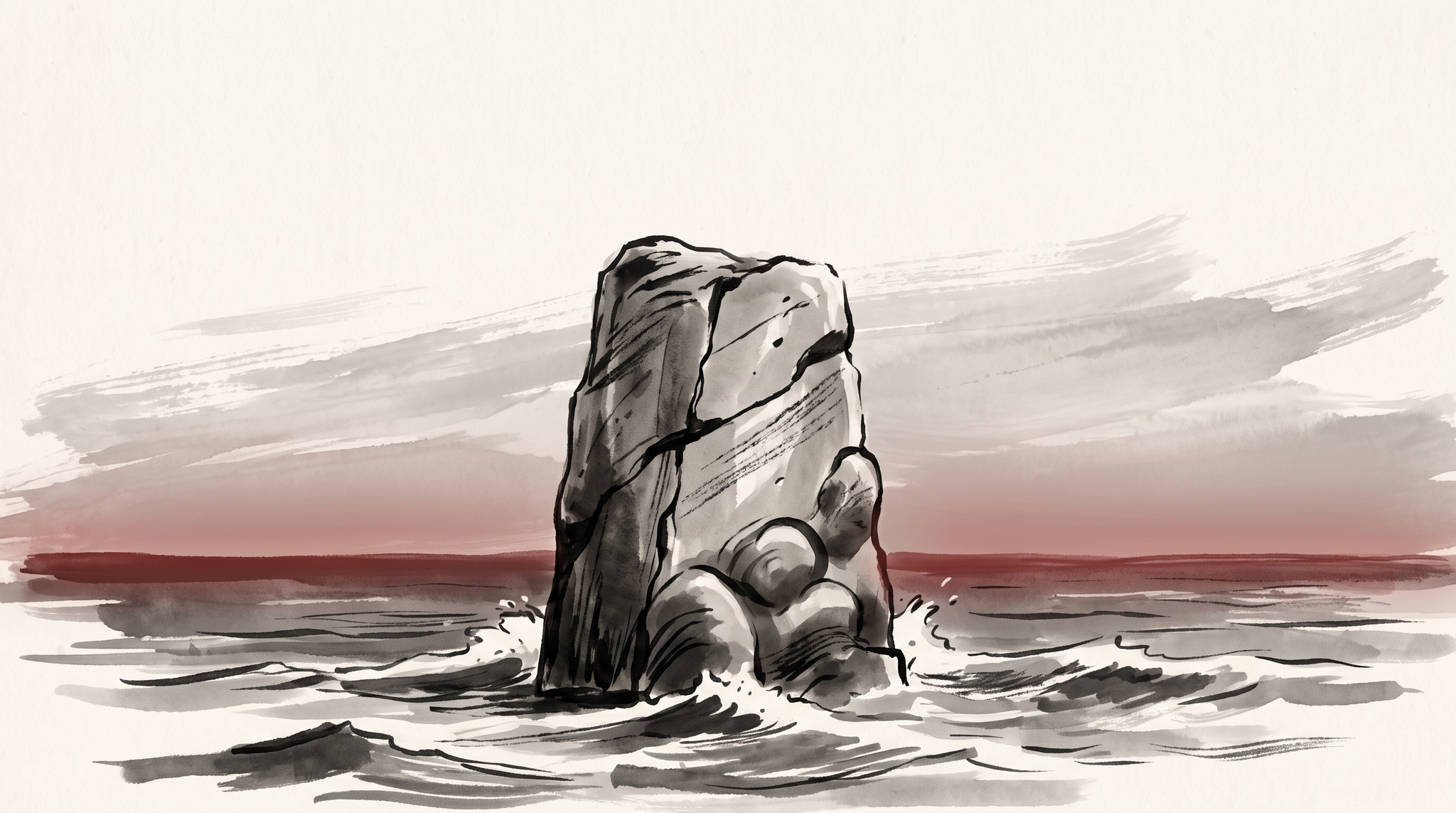
Holiday’s other image stuck with me too: be the rock the waves crash over, calm because the water always settles and the rock is still there. Muddy water goes clear if you let it sit for a second. Stir it every time you get nervous, and it never gets the chance.
Translated into business terms: nobody gets a vote on whether AI reshapes their industry, including you. How you respond to it is the real lever, and just as importantly, so is how you frame that response for the people who work for you. Panic spreads fast inside a company, and calm spreads just as fast if you let it.
Why you can’t outsource wisdom, and what that means for your SOPs
Holiday told a story from Seneca about a wealthy Roman who wanted to seem smart without doing the work. He skipped the studying. He bought educated slaves and had them whisper answers in his ear at dinner parties, so he could sound brilliant on command. A friend eventually needled him about it, suggesting he take up wrestling. The man protested that he was too old. “Ah, but your slaves are still young,” the friend said. The point, in Holiday’s words: “You think you can outsource wisdom, but you can’t outsource wisdom just as you can’t outsource exercise.”
I think about that story every time I watch a team ask an AI tool to write their SOPs for them, ship the document, and move on without anyone actually understanding why the process works the way it does. That’s the exercise-outsourcing trap wearing a business-process costume. Building the workflow gives the team the reasoning behind it, the kind that catches when the process stops fitting reality. That’s what an AI-written SOP skips, and it’s the part that actually matters six months later.
There’s a second layer to this, and it came up in the same conversation. AI widens the gap between a team that already pushes for excellence and a team that already settles. The team with a habit of demanding better work gets a genuine force multiplier out of the tool. The team that’s used to good enough gets to mediocre faster than it ever could before. AI amplifies whatever was already true about how you operate, good habits and bad ones alike.
The neuroscience underneath the stance
Stoicism gives you the posture. Cognitive neuroscientist Chantel Prat explained the actual mechanism on her episode of Beyond The Prompt, and it’s more literal than I expected.
“If you think you already know the answer, you will feel zero curiosity,” Prat said. “And if you feel zero curiosity, your brain is not set up to learn.” That’s true of any new tool, any new hire, any new process. But she went further. If the new thing also feels like a threat, if you’re worried it might replace you or expose you, your brain actively builds defenses and moves away from the experience.
Prat described a model of curiosity from researchers Mathias Gruber and Charan Ranganath called PACE: prediction, appraisal, curiosity, exploration. Your brain first has to register that it doesn’t already know something. Then it runs a safety check, quietly asking whether this new information or experience is dangerous. Only after that appraisal comes back clear does curiosity switch on, and only after curiosity turns on does actual exploration and learning happen.
This is the part most rollout plans get backwards. A leader announces a new AI workflow, expects enthusiasm, and gets quiet resistance instead. The instinct is to explain the tool better, add another training session, repeat the pitch louder. But if the appraisal step already flagged the change as a threat to someone’s job or standing, none of that reaches them, because curiosity never got switched on in the first place. Whether any learning happens at all runs through that safety check first. Rollouts that treat it as an HR footnote are missing the actual mechanism.
Don’t over-systematize the magic
There’s a story from the same conversation with Prat that I’ve been thinking about. A dog-toy company has a head of design whose work everyone internally calls “Bark Magic,” playful, quirky designs that no algorithm has managed to replicate. Leadership kept trying to define exactly what made his work special so they could scale it or eventually automate parts of it. The more precisely they tried to pin it down, the less it looked like what made it valuable in the first place. If you could fully define it, it wouldn’t be magic anymore.
This is the flip side of the SOP point above. Codify the repeatable eighty percent of your work, the parts that genuinely benefit from consistency. But know where the irreducible judgment lives, the part that’s actually your edge, and resist the urge to force it into a checklist just because the tooling now makes that technically possible. Some things get worse the more precisely you try to define them.
Practical habits worth stealing
A few concrete things came out of these conversations that I’ve started using myself.
The first is what Holiday calls the Kissinger move. Henry Kissinger reportedly sent a report back to his staff twice without reading either revision: “this is wrong, do it better” the first time, “no, this is still wrong, I told you to do it better” the second. On the third pass, he finally read it. The lesson applies directly to AI output. There’s no real cost to asking a model to try again. It doesn’t get tired, it doesn’t get offended, and the second draft is usually better than the first. Most people stop at the first draft anyway, out of habit rather than necessity.
The second is naming the fear directly before you expect adoption. Holiday described a conversation with an employee who handles customer service for his company. He could tell she was hesitant about using AI to speed up her work, worried it would make her replaceable. So he told her plainly: “I’m not going to hold that against you.” That one sentence did more for adoption than any tool demo would have, because it addressed the appraisal step directly, the exact thing that has to clear before curiosity can switch on at all.
The third is a reframe Jeremy Utley used on the Prat episode that I’ve adopted as a personal filter. Ask whether AI makes you more yourself. Am I more me with this tool than without it. It’s a simple test, and it sidesteps the entire human-versus-machine framing that makes most of these conversations unproductive in the first place.
Change is the constant. Curiosity is the discipline.
Every generation has stood exactly where we’re standing now, convinced its moment was uniquely disruptive. The technology changes each time. What stays constant is the question underneath it: are you going to meet this with curiosity, or with a threat response dressed up as caution?
I run my own team on a version of this already, specialists for specific jobs, clear written briefs, and a review layer that catches what any single pass misses. What that builds is a team that can respond to whatever shows up next, because something always does.
How you meet it, calm or panicked, deliberate or reactive, is the one thing actually in your control. Everything above was practice for that one move.